Followers

Showing posts with label Indian Removal. Show all posts

Thursday, October 27, 2011

Red Down Below: The Place of Indians in Black/White Dialogue

Preface: It appears that being swamped with work doesn't mean I blog less often, it means I blog more often in shorter bursts. Who knew?


In Wynton Marsalis's Pulitzer Prize Winning oratorio, Blood on the Fields, he condenses US history in this bit of poetry that forms the song's refrain and gives the work its title:

Blood on the fields
King Cotton grow
Brown soil yields
White up above
Red down below
A depiction of cotton-pickers in Texas. Source unknown. http://news.bbc.co.uk/media/images/45173000/jpg/_45173825_187e10b7-bab0-4070-86b8-72dd5e42c3fa.jpg .

Marsalis produces a chilling portrait of the entangled violence and forced labor production that made the US a financially independent nation. In Marsalis's words, a shadowy, unknown force wields the whip and attacks black women's bodies: the blood is already on the fields. If we were to personify these metaphors, it would seem as if the brown soil of black female bodies is giving birth to cotton instead of children. In the lyrics that precede the refrain I quoted, we can see black hands (male and female) "picking, hoeing, feeding, and seeding." In this imagery, enslaved African America births a white supremacist nation ("white up above").

But what of this racial hierachy: white above, red at the absolute bottom with a layer of brown soil between? Black workers and mothers are dramatically present, while the presence of white masters and overseers can be inferred. Indians, however, are already disappeared. While Marsalis's oratorio begins with a wordless chant "To call the Indians out" -- the only place of the so-called "red" people in Blood on the Fields would seem to be in a past that runs quite literally underground: "Red down below." Any blood on the fields would have to be that of tortured African Americans; North America's indigenous peoples are not onstage in this racial conflict, their presence is subterranean, subtextual.

Marsalis's poetic history forms an interesting contrast with Dessalines, the revolutionary general and former slave who is said to have had this reflection on the achievement of Haitian independence from France in 1805:
We have avenged these true cannibals war for war, crime for crime, outrage for outrage; yes, I have saved my country. I have avenged America.
Bucking Columbus's insistence that flesh-eaters were around every corner when he landed at Hispaniola--Dessalines insists that Europeans who decimated and enslaved were cannibalistic in their use of other human beings. But, in reviving the first inhabitants' name for the island, calling the new "black Republic" by the Arawak name of Haiti, was he asserting kinship with an injured but still present people? Or was he promising that blacks would carry on in the name of a cruelly extinguished Amerindian population? In other words, was Dessalines trying to make political connections in the present, or was he lending luster to the first black postcolonial nation through association with the nobility of a vanquished people?

I ask these questions about black uses of the Indian past to open up another question related to a particular conversational habit I've encountered. You might say it's a move akin to that made by whites who would prefer to "talk about class" than about race. Where I posed some pretty stiff rebuttals to that false substitution, I have to say, this one leaves me genuinely perplexed.

Saturday, February 19, 2011

Remembering a Conservative Call for Reparations

This is dedicated to the holders of a particular ideology in my hometown of Cincinnati and its vanilla suburbs. 


Consider this another dispatch from the Blind Squirrel Finds Acorn files. 


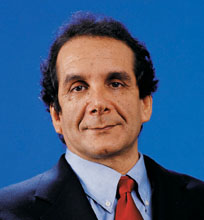
I don't think I had heard of the notion of reparations before I stumbled upon the topic during high school. The unlikely source of my introduction was a 1990 op-ed piece by arch-conservative Charles Krauthammer. He was still an advocate for reparations in 2001. In a surprising departure from the beliefs of his conservative colleagues, Krauthammer did not advocate a Great National Forgetting nor instruct African-Americans simply to Get Over It. Rather, he followed principles recently rearticulated in an article on forgiveness, insisting that for grievances to be suspended, appropriate amends must be offered. I can get behind that vision of social harmony.


Here is Krauthammer in a 2001 rejoinder to David Horowitz: "There is nothing to compare with centuries of state-sponsored slavery followed by a century of state-sponsored discrimination.... Is there a way... to recognize the debt of the past without poisoning the present and future? There is. Reparations. A lump sum compensation does not, of course, make full amends. Nothing can. No one, for example, would pretend that postwar German reparations for the Holocaust made amends. But they were nonetheless extremely important. They gave both symbol and substance to atonement." 


Sounds rather like a Fox News caricature of Jesse Jackson or Al Sharpton, does it not? Well, I assure you, it is the very same Krauthammer who bitterly opposes the Democratic Party and President Obama, the same one who lent his full-throated supported to neocons such as Cheney, Rumsfeld, et al.


Fleshing out his program for reparations, Krauthammer goes on to suggest that something on the order of $50,000 be given to every African-American family in exchange for, well, shutting up forever about the whole effects of slavery, rape, lynching, joblessness, arson, depressed wages, baseless incarceration, and residential segregation thing. One wonders if he still feels the same way now that the "budget surplus" from which he proposed drawing the $440 billion in reparations has blown away in an Iraqi sandstorm...

I have my own reservations about some of the premises and details of the project, but I do not disagree with its basic vision of redress. However, I would imagine that most white Americans would balk at Krauthammer's proposal, even in the best of economic times. Across the broad middle of the ideological spectrum and across a variety of class positions, most would offer an alliterative slogan of Hard Work and not Handouts. At this point, many would begin to talk about an immigrant grandfather who "came to this country with nothing" but, through a disciplined work ethic and frugality, moved the family into the middle class. 


I do not dispute the existence of these Grand Fathers. But is the story of the middle class, told in aggregate, a story of self-reliant individuals who, spontaneously and simultaneously, chose to work hard and save their money? Or is the American middle-class the product of large-scale social projects? After the jump, I synthesize the work of historians to show that the middle class was the product of elite political and financial decision-makers. Were it not for these large-scale social projects, American society would have settled into something like feudalism or the oligarchies of the decolonized world.