I may not bring 400 hundred years of slavery and oppression to Lincoln--I'm not that old. But I do bring two films worth of acid reflux to this latest attempt by le Spielberg to deal with the Negro question. So, in addition to *SPOILING THE PLOT* of Lincoln, I fear this post may also spoil the cheering over the national reunification the film wants to praise and call forth again.
My first disappointment with Spielberg's colored people was in The Color Purple. To keep this part brief, suffice it to say that I don't mind films differing from books. I do mind when they veer from the womanist politics of the novel by having the one female character who is independent of the story's violent men turn 180 degrees for no reason to cry out "Papa, I'se married!" That's not a difference; that's a violation of the whole spirit of the enterprise.
More recently, in the days of Amistad, Speilberg said (on Oprah, with Debbie Allen near him for backup) that he wanted to create a story so that his adopted black children could be proud of their country. I kept thinking that there is another option: help create a country your adopted black children can be proud of. In any case, this desire to exculpate the nation led him to the absolutely false courtroom climax in which John Quincy Adams wins the freedom of the Amistad mutineers through an impassioned Abolitionist speech when, in fact, JQA argued that, as they revolted at sea and were not yet the property of a slaveholder in the Americas, they should be free to return home. JQA was an unlikely hero for a story of the triumph of colorblindness anyway, he who withheld his sympathy from Desdemona in a review of Othello, because he believed that nature would always punish such outrages as sex across the color line.
So I come to Lincoln not primed to be pleased.
Showing posts with label reparations. Show all posts
Showing posts with label reparations. Show all posts
Saturday, March 2, 2013


Saturday, February 19, 2011
Remembering a Conservative Call for Reparations
This is dedicated to the holders of a particular ideology in my hometown of Cincinnati and its vanilla suburbs.
Consider this another dispatch from the Blind Squirrel Finds Acorn files.
I don't think I had heard of the notion of reparations before I stumbled upon the topic during high school. The unlikely source of my introduction was a 1990 op-ed piece by arch-conservative Charles Krauthammer. He was still an advocate for reparations in 2001. In a surprising departure from the beliefs of his conservative colleagues, Krauthammer did not advocate a Great National Forgetting nor instruct African-Americans simply to Get Over It. Rather, he followed principles recently rearticulated in an article on forgiveness, insisting that for grievances to be suspended, appropriate amends must be offered. I can get behind that vision of social harmony.
 Here is Krauthammer in a 2001 rejoinder to David Horowitz: "There is nothing to compare with centuries of state-sponsored slavery followed by a century of state-sponsored discrimination.... Is there a way... to recognize the debt of the past without poisoning the present and future? There is. Reparations. A lump sum compensation does not, of course, make full amends. Nothing can. No one, for example, would pretend that postwar German reparations for the Holocaust made amends. But they were nonetheless extremely important. They gave both symbol and substance to atonement."
Sounds rather like a Fox News caricature of Jesse Jackson or Al Sharpton, does it not? Well, I assure you, it is the very same Krauthammer who bitterly opposes the Democratic Party and President Obama, the same one who lent his full-throated supported to neocons such as Cheney, Rumsfeld, et al.
Consider this another dispatch from the Blind Squirrel Finds Acorn files.
I don't think I had heard of the notion of reparations before I stumbled upon the topic during high school. The unlikely source of my introduction was a 1990 op-ed piece by arch-conservative Charles Krauthammer. He was still an advocate for reparations in 2001. In a surprising departure from the beliefs of his conservative colleagues, Krauthammer did not advocate a Great National Forgetting nor instruct African-Americans simply to Get Over It. Rather, he followed principles recently rearticulated in an article on forgiveness, insisting that for grievances to be suspended, appropriate amends must be offered. I can get behind that vision of social harmony.
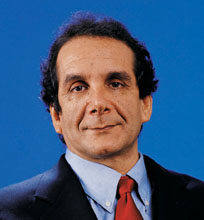 Here is Krauthammer in a 2001 rejoinder to David Horowitz: "There is nothing to compare with centuries of state-sponsored slavery followed by a century of state-sponsored discrimination.... Is there a way... to recognize the debt of the past without poisoning the present and future? There is. Reparations. A lump sum compensation does not, of course, make full amends. Nothing can. No one, for example, would pretend that postwar German reparations for the Holocaust made amends. But they were nonetheless extremely important. They gave both symbol and substance to atonement."
Sounds rather like a Fox News caricature of Jesse Jackson or Al Sharpton, does it not? Well, I assure you, it is the very same Krauthammer who bitterly opposes the Democratic Party and President Obama, the same one who lent his full-throated supported to neocons such as Cheney, Rumsfeld, et al.
Fleshing out his program for reparations, Krauthammer goes on to suggest that something on the order of $50,000 be given to every African-American family in exchange for, well, shutting up forever about the whole effects of slavery, rape, lynching, joblessness, arson, depressed wages, baseless incarceration, and residential segregation thing. One wonders if he still feels the same way now that the "budget surplus" from which he proposed drawing the $440 billion in reparations has blown away in an Iraqi sandstorm...
I have my own reservations about some of the premises and details of the project, but I do not disagree with its basic vision of redress. However, I would imagine that most white Americans would balk at Krauthammer's proposal, even in the best of economic times. Across the broad middle of the ideological spectrum and across a variety of class positions, most would offer an alliterative slogan of Hard Work and not Handouts. At this point, many would begin to talk about an immigrant grandfather who "came to this country with nothing" but, through a disciplined work ethic and frugality, moved the family into the middle class.
I do not dispute the existence of these Grand Fathers. But is the story of the middle class, told in aggregate, a story of self-reliant individuals who, spontaneously and simultaneously, chose to work hard and save their money? Or is the American middle-class the product of large-scale social projects? After the jump, I synthesize the work of historians to show that the middle class was the product of elite political and financial decision-makers. Were it not for these large-scale social projects, American society would have settled into something like feudalism or the oligarchies of the decolonized world.
I do not dispute the existence of these Grand Fathers. But is the story of the middle class, told in aggregate, a story of self-reliant individuals who, spontaneously and simultaneously, chose to work hard and save their money? Or is the American middle-class the product of large-scale social projects? After the jump, I synthesize the work of historians to show that the middle class was the product of elite political and financial decision-makers. Were it not for these large-scale social projects, American society would have settled into something like feudalism or the oligarchies of the decolonized world.
Subscribe to:
Posts (Atom)